If you’ve just had a dry needling treatment and you’re wondering whether you can hit the gym tonight, the honest answer depends on which muscles were treated, how intense the session was, and what you’re planning to do.
Most patients need 24–48 hours of relative rest before returning to normal activity, stepping back from intense exercise and anything high-impact, while keeping up with gentle movement and light walking from day one.
Over 60% of patients experience mild soreness after dry needling – and some research puts the figure considerably higher. Yet most leave their first session without a clear picture of what to expect after dry needling or how to manage it.
This guide covers everything.
How Long Should You Rest After Dry Needling?
Most people should avoid strenuous activity for 24–48 hours after receiving dry needling. Light daily activity is safe from the same day, and full return to normal training is typically appropriate after 48 hours once soreness has resolved.
“Rest” here means relative rest, not lying on the couch all day.
It means stepping back from anything that aggressively loads the muscles just treated. Gentle movement is actively part of the recovery process. It promotes circulation to the treated tissue, which is how the body delivers reparative cells to the area and clears the metabolic waste responsible for that deep, achy muscle pain.
Here’s why the recovery window matters as much as the session itself: the needle creates a controlled micro-injury in muscle tissue, triggering an inflammatory cascade that begins remodelling dysfunctional tissue. Load that muscle heavily before that process has taken hold and you interfere with the repair cycle before it delivers results.
First-time patients almost always need more recovery time than those several sessions in, as the body becomes progressively more efficient at responding to the stimulus. Age, hydration status, and how much sleep you got the night before all play a role too.
Return to Activity: Quick Reference
| Activity | When It’s Safe |
|---|---|
| Light walking, desk work | Same day |
| Gentle stretching, yoga | 24 hours |
| Gym / moderate training | 48 hours |
| Heavy lifting, high-intensity training | 48 hours (once soreness has resolved) |
| Competitive sport | 48–72 hours depending on muscles treated |
| Massage on treated area | 24 hours |
What to Expect Before, During, and After a Dry Needling Treatment
Before the session
Your chiropractor or therapist will assess the muscles involved, identify which trigger points need targeting, and walk you through what you may feel during and after the session.
Trigger points are the tight, hypersensitive knots in muscle tissue responsible for pain, restricted mobility, and muscle tension. For first sessions, intensity is kept conservative — the goal is to see how your body responds before progressing.
During the session
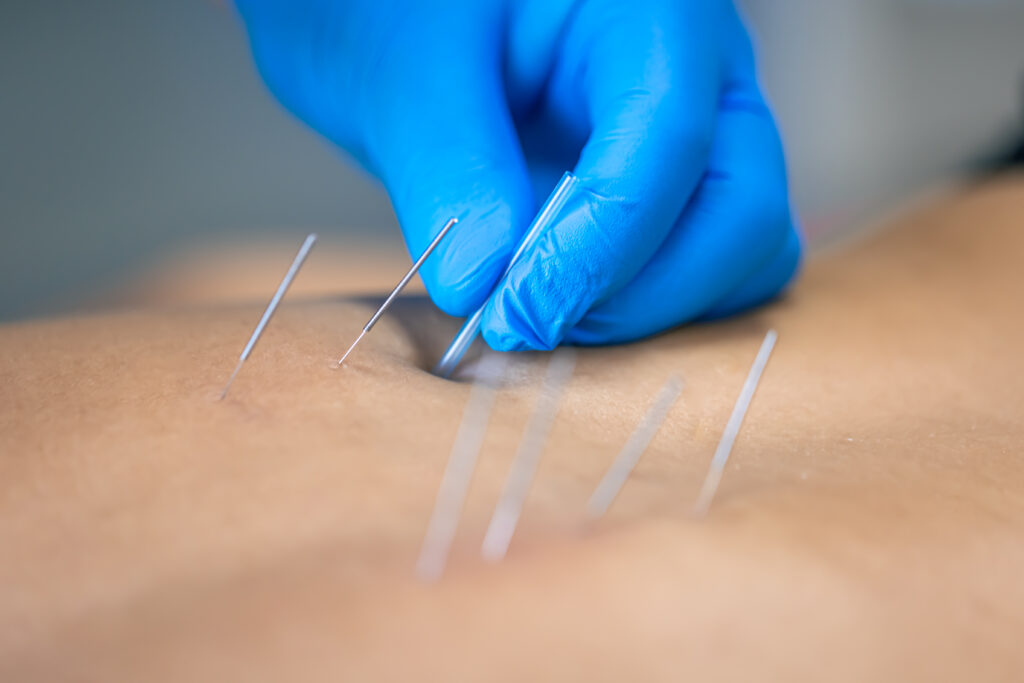
The main sensation to expect is the local twitch response – a brief, involuntary muscle contraction when the needle contacts a trigger point.
It feels like a sudden deep cramp or ache, sometimes with a radiating sensation into nearby areas. It can be surprising the first time, but it’s a good sign. That twitch is the muscle releasing, which is exactly what the treatment is designed to trigger.
Immediately after
Most patients feel a sense of release or unexpected lightness in the treated area straight away – almost like a reset. Enjoy it – it doesn’t always last.
Mild soreness typically sets in two to four hours after the session, peaks somewhere in the 24–48 hour window, and then clears by day three. By that point, the original complaint has usually improved meaningfully.
For the rest of the day, four things make the biggest difference:
Keep moving gently. If you’re desk-based, getting up for a few minutes every hour does more than a single walk at the end of the day. Light stretching and gentle range of motion movements increase blood flow to the tissue and clear metabolic waste far more effectively than complete rest.
Stay hydrated. Well-hydrated tissue clears waste faster and soreness resolves sooner. Aim for at least an extra litre on the day of and the day after your session.
Apply heat — but not yet. Avoid direct heat in the first 2–4 hours while the needle sites are still acutely inflamed. After that, a heat pack for 15–20 minutes, two or three times across the first 48 hours, promotes circulation and eases soreness significantly.
Protect your sleep. Avoid alcohol before bed on the night of your session. It disrupts the deep sleep stages where the bulk of tissue repair happens — and it’s one of the most common reasons soreness lingers longer than it should.
What Not to Do After Dry Needling
1. Intense exercise and heavy lifting
Loading treated muscles before the healing cycle completes is the most common reason patients feel dry needling treatment didn’t work — the process was interrupted before it could finish. Give the tissue the time it needs, and don’t overdo it on the return to training either.
2. Avoid these substances: alcohol and NSAIDs
Two things that reliably interfere with recovery deserve special mention together.
Alcohol dehydrates the body and undermines its ability to flush metabolic waste from treated tissue. Patients who socialise the evening of their session reliably report worse soreness the next day.
NSAIDs, ibuprofen and similar anti-inflammatories, should also be avoided for 48 hours where possible. The inflammation dry needling triggers is the mechanism through which healing occurs. Suppress it prematurely and you may reduce how effectively the treatment works. If pain relief is needed, paracetamol is the recommended alternative.
Avoid both substances for at least 24–48 hours post-treatment.
3. Direct heat in the first 2–4 hours
Heat can aggravate needle sites while they’re still acutely inflamed. After that window, it becomes actively beneficial — a heat pack for 15–20 minutes, two or three times across the first 48 hours, promotes circulation and helps relieve muscle pain.
4. Hot baths and saunas in the first 4–6 hours
The combination of heat, vasodilation, and dehydration risk isn’t helpful immediately post-session. After that window, a warm Epsom salt bath is actually a useful recovery tool.
5. Ice on the treated area
This one surprises people. Ice suppresses the inflammatory response that drives healing — the same reason NSAIDs are avoided. If you’d normally reach for ice after an injury, this is an exception where it works against the treatment.
6. Staying completely still
Prolonged static postures reduce blood flow and slow the body’s ability to clear metabolic byproducts. Light movement throughout the day is far more supportive than stillness.
Is Soreness After Dry Needling Normal?
Yes, and it’s more common than most people expect.
Research places the prevalence of post-needling soreness anywhere from 50% to over 80% of patients depending on the study. The mild soreness is a sign the treatment is doing its job: when the needle contacts a trigger point and causes that muscle twitch, it creates a small amount of controlled irritation in the tissue, and that irritation is what kicks off the healing process.
Most patients describe it as that deep, hard-to-pinpoint ache you get after a hard workout — the kind where you feel muscles you didn’t know you had. It typically comes with some tenderness to touch and mild stiffness in the treated area. Occasional mild bruising at the needle site is also normal and clears within a day or two.
The soreness peaking before things improve is actually a good sign clinically. It means the tissue is responding.
One thing to watch for: if the pain feels sharp, shooting, or is getting progressively worse rather than gradually easing, that’s outside the normal pattern and worth a call to your therapist.
Does Dry Needling Make You Tired?
Yes, and it catches most patients off guard.
The session itself doesn’t feel that demanding while it’s happening. But quite a lot is going on beneath the surface. Every time a needle triggers that muscle twitch, the nervous system has to respond and initiate the healing response. That takes real energy – more than it might seem.
Patients having multiple trigger points treated, or those coming in for the first time, tend to feel it the most. You may feel flat or heavy for a few hours afterwards — think of it as your body’s way of hitting reset while it does the repair work. Many patients also sleep better that night than they have in a while.
Where possible, avoid scheduling a dry needling treatment before a demanding afternoon. If tiredness is still hanging around after 48 hours, let your healthcare provider know — it’s usually a sign the session intensity needs to be dialled back slightly next time.
How Dry Needling Fits Into Your Treatment Plan
Dry needling treatment rarely works best in isolation. At Complete Chiropractic Sports & Wellness, it’s frequently used as part of an integrated treatment plan that includes chiropractic care and other manual therapies.
Here’s how the pieces fit together. Chiropractic care addresses spinal alignment and joint mobility – the structural side of musculoskeletal pain. Dry needling targets the muscular component directly, releasing trigger points that restrict muscle function and contribute to pain. Massage can be added to the plan, though not on the treated area within the first 24 hours – it works well on surrounding tissue in that window and more broadly once soreness has resolved.
Most patients find this combined approach delivers faster, more durable results than any single treatment in isolation. Most conditions respond meaningfully within three to six sessions of dry needling, with recovery from each session becoming progressively easier as the tissue adapts.
Frequently Asked Questions
Is dry needling the same as acupuncture?
No. They use the same tool – thin needles – but are fundamentally different in approach. Acupuncture follows traditional Chinese medicine meridian principles. Dry needling is a Western clinical technique targeting specific trigger points in muscle tissue to restore muscle function and relieve pain. The recovery also differs: acupuncture rarely produces significant localised muscle soreness, whereas dry needling typically does.
Can I use ice after dry needling?
Ice is generally not recommended on the treated area. Because the treatment works by triggering a localised inflammatory response to increase blood flow and begin tissue repair, suppressing that with ice may interfere with its effectiveness. After the 4–6 hour mark, gentle heat is the better choice.
How many sessions of dry needling will I need?
Most conditions respond meaningfully within three to six sessions. Recovery from each session becomes easier as the tissue adapts: patients who experience significant soreness after session one are often barely affected by session five. Depending on your cover, insurance does not cover dry needling costs – do keep this in mind when planning for sessions.
When Should You Be Concerned After Dry Needling?
Serious adverse events are extremely rare with dry needling. That said, contact your healthcare provider if you experience any of the following: sharp or worsening pain distinct from the expected dull ache, significant swelling beyond the needle site, new numbness or tingling, soreness not improving after 72 hours, or signs of infection – persistent redness, warmth, or discharge at needle sites.
For sessions involving the upper back or thorax, there is an extremely rare risk of pneumothorax. Shortness of breath and chest pain following needling in those areas should be assessed medically rather than waited out.
At Complete Chiropractic Sports & Wellness, we always encourage patients to reach out between sessions if something doesn’t feel right. An open line of communication — even for minor concerns, is part of good clinical care.
Sources
- Gattie E, Cleland JA, Snodgrass S. The effectiveness of trigger point dry needling for musculoskeletal conditions by physical therapists: a systematic review and meta-analysis. Journal of Orthopaedic & Sports Physical Therapy. 2017;47(3):133–149. https://doi.org/10.2519/jospt.2017.7096
- Dommerholt J, Fernández-de-las-Peñas C. Trigger Point Dry Needling: An Evidence and Clinical-Based Approach. Churchill Livingstone Elsevier; 2013.
- Martín-Pintado-Zugasti A, et al. Post-needling soreness after myofascial trigger point dry needling: Current status and future research. Journal of Bodywork and Movement Therapies. 2018;22(4):941–946. https://doi.org/10.1016/j.jbmt.2018.01.003
- Brady S, McEvoy J, Dommerholt J, Doody C. Adverse events following trigger point dry needling: a prospective survey of chartered physiotherapists. Journal of Manual & Manipulative Therapy. 2014;22(3):134–140. https://doi.org/10.1179/2042618613Y.0000000044
- Interventions to reduce soreness after dry needling: a systematic review. JOSPT Open. 2024. https://doi.org/10.2519/josptopen.2024.0610
- Dunning J, et al. Dry needling: a literature review with implications for clinical practice guidelines. Physical Therapy Reviews. 2014;19(4):252–265. https://doi.org/10.1179/108331913X13844245102034
- Boyles R, Fowler R, Ramsey D, Burrows E. Effectiveness of trigger point dry needling for multiple body regions: a systematic review. Journal of Manual & Manipulative Therapy. 2015;23(5):276–293. https://doi.org/10.1179/2042618615Y.0000000014

Meet Dr. Kevin McLaughlin
Dr. Kevin McLaughlin is the owner of Complete Chiropractic Sports and Wellness and has been serving the Triangle community since 2012. Originally from Shenandoah Junction, West Virginia, he graduated from Palmer College of Chiropractic and opened his practice with a focus on natural, holistic healing.
He takes a comprehensive approach to care, specializing in techniques such as Cranial Facial Release, spinal decompression, dry needling, shockwave therapy, and cold laser therapy. His philosophy centers on treating the body as a whole and addressing the root cause of pain, rather than just managing symptoms.
Dr. McLaughlin is passionate about helping patients move better, feel better, and live healthier lives, while supporting each individual’s long-term wellness goals.
Outside the clinic, he enjoys golf, staying active, music, and the outdoors, and is a proud father to his two children, River and Aria.