Most insurance plans don’t cover dry needling as a standalone service, but depending on your plan type, diagnosis, and how treatment is billed, there are more options than most people expect.
Most patients are surprised to find out the question isn’t really “is dry needling covered”, it’s “how is it being billed.”
This guide gives you the honest breakdown, and what to do when your plan says no.
Is Dry Needling Covered by Insurance?
Dry needling isn’t covered as a standalone service under most standard commercial plans, but coverage does exist in specific situations.
Workers’ comp and auto insurance (Personal Injury Protection) are more likely to cover dry needling because treatment is tied to a specific injury or accident, not a general health plan. Within commercial insurance, your specific plan matters far more than your insurer’s name. The sections below break each one down.
1. Private / Commercial Insurance
Private insurance does not cover dry needling as a standalone service for most patients. Major carriers — Aetna, Cigna, United Healthcare, Humana – classify it as investigational or unproven, meaning claims are denied at first submission as standard policy.
That classification is administrative, not clinical. The evidence supporting dry needling for muscle and trigger point pain is well-established, and many patients that book with us see results that massage, injections, and standard PT haven’t delivered.
Does the provider type affect coverage?
Yes. Insurance companies treat physical therapists, chiropractors, and acupuncturists differently, and that affects how a dry needling claim gets processed, even if the technique is identical.
A PT or chiropractor billing dry needling as part of a broader treatment visit has more flexibility than a standalone dry needling session. If the visit includes other covered services – spinal manipulation, soft tissue work, therapeutic exercise – the claim may go through even when dry needling alone wouldn’t be reimbursed.
Here at Complete Chiropractic Sports & Wellness, dry needling is integrated into a broader treatment plan, so the visit may contain covered services even when dry needling alone wouldn’t be reimbursed.
If you’re comparing providers, ask specifically how they bill and what else is included in the visit.
2. Medicare Coverage for Dry Needling
Medicare does not cover dry needling as a general musculoskeletal treatment but there’s a narrow exception most guides miss.
Since 2020, the Centers for Medicare & Medicaid Services (CMS) has moved to cover acupuncture for chronic lower back pain specifically and Medicare may cover dry needling under that same benefit, though coverage depends on your provider’s specific credentials – confirm with your clinic directly before assuming this exception applies.
This coverage falls under Medicare Part B – the part that covers outpatient treatment and doctor visits, as opposed to Part A which covers hospital stays, and the parameters are strict:
- Up to 12 sessions in a 90-day period
- Up to 8 additional sessions if the patient shows improvement
- A maximum of 20 sessions per year
- Applies only to chronic back pain (12+ weeks, no identifiable systemic cause)
For shoulder, hip, neck, headaches, musculoskeletal pain in other areas, or any other condition, Medicare coverage does not apply.
Something to consider:
If you have a Medicare Advantage plan: a private insurance plan that bundles your Medicare benefits, it’s worth calling directly, as many include additional alternative care benefits that go beyond standard Medicare coverage.
3. Blue Cross Blue Shield of North Carolina
Blue Cross Blue Shield (BCBS) NC does not currently cover dry needling as a standalone service, citing insufficient evidence in their published clinical policy.
The clinical evidence for dry needling has grown significantly and the outcomes we see daily at Complete Chiropractic Sports & Wellness speak for themselves.
The important nuance: if you have BCBS NC through an employer, your plan may be self-funded, meaning your employer sets the benefit structure independently of BCBS NC’s standard policy. That’s where some patients find coverage the default policy doesn’t show. Verify your specific plan directly before assuming denial.
4. Workers’ Compensation
Workers’ comp covers dry needling, and it’s one of the more straightforward paths to getting it approved.
These policies are considerably more flexible than standard health insurance, covering both acute soft tissue injuries and chronic myofascial pain from a workplace incident. The deciding factor is documentation: a formal diagnosis, functional outcome measures, and defined treatment goals.
We handle workers’ comp cases at Complete Chiropractic Sports & Wellness and prepare the documentation that gives claims the strongest foundation.
5. Personal Injury Protection (PIP)
Auto PIP is another viable coverage path for dry needling. If you were injured in a vehicle accident and are dealing with muscle pain, tightness, headaches, or soft tissue dysfunction, dry needling as part of your recovery may be covered. PIP policies operate similarly to workers’ comp in terms of flexibility. We work directly with PIP carriers and manage auto injury cases from documentation through reimbursement.
6. Medicaid
Medicaid does not cover dry needling in most cases. Most state Medicaid programs do not include it as a benefit, and coverage for dry needling varies from state to state. Because Medicaid is state-administered, it’s worth a direct call to confirm — but coverage is not available through most programs.
7. Tricare
Tricare does not cover dry needling outside of a narrow exception. It generally follows Medicare guidelines, meaning no coverage outside the chronic back pain exception noted above.
Active-duty members may have additional access through military treatment facilities, which is worth a direct inquiry before assuming denial.
Can You Use HSA or FSA Funds for Dry Needling?
Yes, HSA, FSA, and HRA funds can generally be used for dry needling when your provider documents a specific diagnosis and care plan. For patients without insurance coverage, this is often the most practical and immediate option available to pay out of pocket without using after-tax dollars.
You’ll need an itemized receipt with your ICD-10 diagnosis code and relevant CPT code – both included as standard on every receipt we provide at Complete Chiropractic Sports & Wellness. We accept HSA and FSA cards directly and prepare Letters of Medical Necessity when your administrator requires them.
A heads-up:
Some FSA administrators flag dry needling treatments due to its investigational classification. Having the diagnosis code and a brief clinical rationale on the receipt upfront preempts most delays.
How Much Does Dry Needling Cost Without Insurance?
Without insurance, dry needling in Durham, NC typically costs $40–$100 per standalone session in 2026.
Out-of-pocket costs vary depending on how many muscles are treated and whether dry needling is bundled within a broader visit.
Here’s the full breakdown:
- Per session (standalone) — $40–$100
- Bundled with a chiropractic or PT visit — $80–$180 total
- Standard course (4–8 sessions) — $300–$700
- Comprehensive program (8–15 sessions) — $600–$1,400
For context on how that compares to the alternatives:
- Cortisone injection — $100–$300, temporary symptom relief with no tissue repair
- Dry needling course (6–10 sessions) — $300–$700, addresses the trigger point source directly
- Orthopedic surgery — $10,000–$50,000+, invasive with significant recovery time
A full course is frequently the most cost-effective path to lasting relief, especially compared to repeated cortisone injections or the trajectory toward surgery.
What are the CPT Codes for Dry Needling?
The CPT codes for dry needling were introduced by the AMA in 2020 – and knowing them is one of the most useful things you can do before calling your insurer. CPT codes 20560 and 20561 are the correct billing codes for dry needling procedures:
- CPT 20560 — Needle insertion(s) without injection, 1 or 2 muscles
- CPT 20561 — Needle insertion(s) without injection, 3 or more muscles
Call your insurer and ask whether these codes appear on your plan’s fee schedule. If they do, you have a reimbursement pathway most patients never think to ask about.
What to Do If Your Insurance Denies Dry Needling
If your insurance denies dry needling, don’t accept it as a final answer.
Here’s the process to appeal:
- Request the denial in writing — the exact policy exclusion, clause reference, and effective date.
- Understand the language. “Experimental” means no evidence exists. “Investigational” means evidence exists but the insurer hasn’t completed its review — and the clinical evidence for dry needling gives you real grounds for appeal. If they say it’s not medically necessary, that determination can be challenged with the right documentation.
- Get a diagnosis-specific Letter of Medical Necessity — one naming your diagnosis, clinical rationale, supporting research, and measurable goals. A generic letter doesn’t get read. We prepare these for our patients at Complete Chiropractic Sports & Wellness.
- File a formal internal appeal, paired with published research specific to your condition.
- Escalate to external review. Under the ACA, most plans must offer independent external review when internal appeals fail. Approval rates are meaningfully higher at this stage.
We provide the documentation, clinical justification, and CPT coding our patients need to mount a real appeal. You don’t have to figure this out alone.
What to Ask Your Insurance Company Before Your First Dry Needling Session
Before your first session, call the member services number on your card and ask these questions directly:
- Is dry needling covered under my specific plan?
- Are CPT codes 20560 and 20561 on your fee schedule?
- Do I need prior authorization?
- Does my diagnosis affect the medical necessity determination?
- Can I use HSA or FSA funds if it’s not covered?
Write down the date, the rep’s name, and the reference number. If they say it’s not covered, that’s your cue to move into the appeal process outlined above.
What to expect at the front desk
One thing patients rarely think to ask: how does payment actually work on the day of the visit?
At most clinics that don’t bill insurance for dry needling, you’ll pay at the time of service and receive a superbill — an itemized receipt with your diagnosis code, CPT codes, and provider information — that you can submit to your insurer yourself for potential out-of-network reimbursement.
Some plans will reimburse a percentage even when the provider isn’t in-network.
At Complete Chiropractic Sports & Wellness, we provide superbills as standard, accept HSA and FSA cards directly, and can walk you through submission if you want to pursue reimbursement on your own. No surprises at checkout.
What Is Dry Needling?
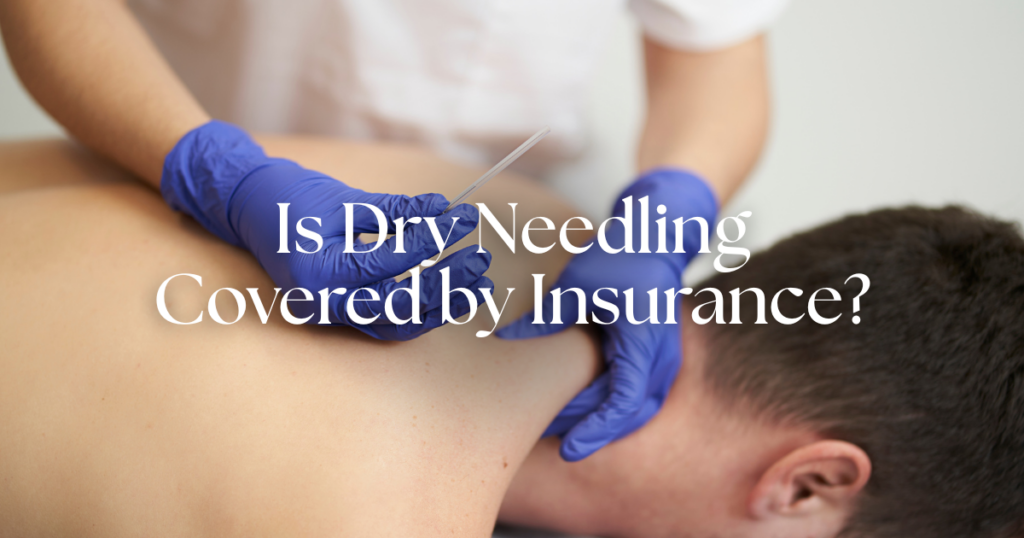
Dry needling is a technique used in musculoskeletal care that involves inserting a thin filiform needle directly into a myofascial trigger point: a tight, irritable band within a muscle responsible for referred pain and restricted movement.
The needle causes a local twitch response in the muscle, which releases tension, improves blood flow, and kickstarts the tissue repair process.
Unlike broader physical therapy approaches that work around the problem, dry needling addresses the trigger point directly, making it one of the more targeted techniques used in pain management and injury recovery.
It’s commonly confused with acupuncture, which uses similar needles but is rooted in Traditional Chinese Medicine.
Dry needling is grounded in Western anatomy and neuroscience -a distinct clinical framework, with distinct training requirements and distinct billing codes.
Is Dry Needling Worth It If Insurance Doesn’t Cover It?
For the right condition, yes – often significantly so. The effectiveness of dry needling is well-supported by research across a range of clinical scenarios.
A systematic review covering studies published between 2000 and 2023 concluded that dry needling is an effective procedure for treating myofascial pain in patients with both acute and chronic low back pain.
A separate 2021 meta-analysis also found consistent effects of trigger point dry needling for nontraumatic shoulder pain of musculoskeletal origin.
Where manual therapy alone hasn’t resolved the problem, dry needling often fills the gap, and outcomes are documented in the medical record from the first visit here at Complete Chiropractic Sports & Wellness, so progress is trackable session to session.
Receiving dry needling tends to deliver the clearest out-of-pocket value for:
- Chronic myofascial pain that hasn’t responded to massage or standard physical therapy
- Referred pain patterns – shoulder, neck, hip, with no structural cause on imaging
- Tension headaches and jaw pain driven by trigger points
- Post-injury muscle tightness that lingers after the acute phase resolves
- Athletes dealing with recurrent muscle dysfunction between training cycles
Where it may not be the right first step: acute injuries in the first 72 hours, conditions needing structural intervention, or unconfirmed diagnoses. Our free pre-session evaluation at our Durham clinic determines fit before you commit to anything.
Dry Needling Near Durham, NC — Complete Chiropractic Sports & Wellness
If you’re in Durham, Raleigh, Chapel Hill, Cary, or Morrisville, Complete Chiropractic Sports & Wellness offers trigger point dry needling as part of an integrated, evidence-based approach to pain management and injury recovery. We verify benefits before your first visit, prepare HSA/FSA-ready documentation, handle workers’ comp and PIP cases, and offer payment plans with no hidden fees.
If you’re in pain and unsure what you can afford to do about it – come in for a free consultation. We’ll work through the coverage picture with you first.
Sources
- Low back pain systematic review (2023): https://pubmed.ncbi.nlm.nih.gov/38157883/ ; https://pmc.ncbi.nlm.nih.gov/articles/PMC10756779/
- Low back pain meta-analysis: https://pubmed.ncbi.nlm.nih.gov/36399082/
- Shoulder pain meta-analysis (2021): https://pubmed.ncbi.nlm.nih.gov/33340405/ ; https://academic.oup.com/ptj/article/101/2/pzaa216/6042194
- Musculoskeletal umbrella review (2023): https://www.mdpi.com/2077-0383/12/3/1205
- Medicare Decision Memo — Acupuncture for Chronic Low Back Pain: https://www.cms.gov/medicare-coverage-database/view/ncacal-decision-memo.aspx?proposed=N&NCAId=295
- Medicare Press Release — CMS Finalizes Acupuncture Coverage: https://www.cms.gov/newsroom/press-releases/cms-finalizes-decision-cover-acupuncture-chronic-low-back-pain-medicare-beneficiaries
- Medicare NCD 30.3.3 — Acupuncture for Chronic Lower Back Pain: https://www.cms.gov/medicare-coverage-database/view/ncd.aspx?NCDId=373
- CPT Codes 20560 & 20561 — ACA New Dry Needling Codes: https://www.acatoday.org/news-publications/new-dry-needling-codes-included-in-cpt-2020/
- CPT Billing Guide — Needle Insertion Without Injection: https://www.acatoday.org/news-publications/billing-for-dry-needling-services-needle-insertion-without-injection/
- CPT 2020 Code Changes Overview: https://www.enlyte.com/insights/article/bill-review/2020-cpt-code-changes-what-you-need-know
- BCBS NC Policy — Dry Needling of Myofascial Trigger Points: https://www.bluecrossnc.com/providers/policies-guidelines-codes/commercial/other-treatments/updates/dry-needling-of-myofascial-trigger-points
- IRS Publication 502 — Medical and Dental Expenses: https://www.irs.gov/publications/p502
- IRS Publication 969 — HSA and Tax-Favored Health Plans: https://www.irs.gov/publications/p969
- FSA/HSA Eligibility for Dry Needling: https://buyfsa.com/blogs/fsa-hsa-eligibility-list/is-dry-needling-fsa-hsa-eligible

Meet Dr. Kevin McLaughlin
Dr. Kevin McLaughlin is the owner of Complete Chiropractic Sports and Wellness and has been serving the Triangle community since 2012. Originally from Shenandoah Junction, West Virginia, he graduated from Palmer College of Chiropractic and opened his practice with a focus on natural, holistic healing.
He takes a comprehensive approach to care, specializing in techniques such as Cranial Facial Release, spinal decompression, dry needling, shockwave therapy, and cold laser therapy. His philosophy centers on treating the body as a whole and addressing the root cause of pain, rather than just managing symptoms.
Dr. McLaughlin is passionate about helping patients move better, feel better, and live healthier lives, while supporting each individual’s long-term wellness goals.
Outside the clinic, he enjoys golf, staying active, music, and the outdoors, and is a proud father to his two children, River and Aria.